

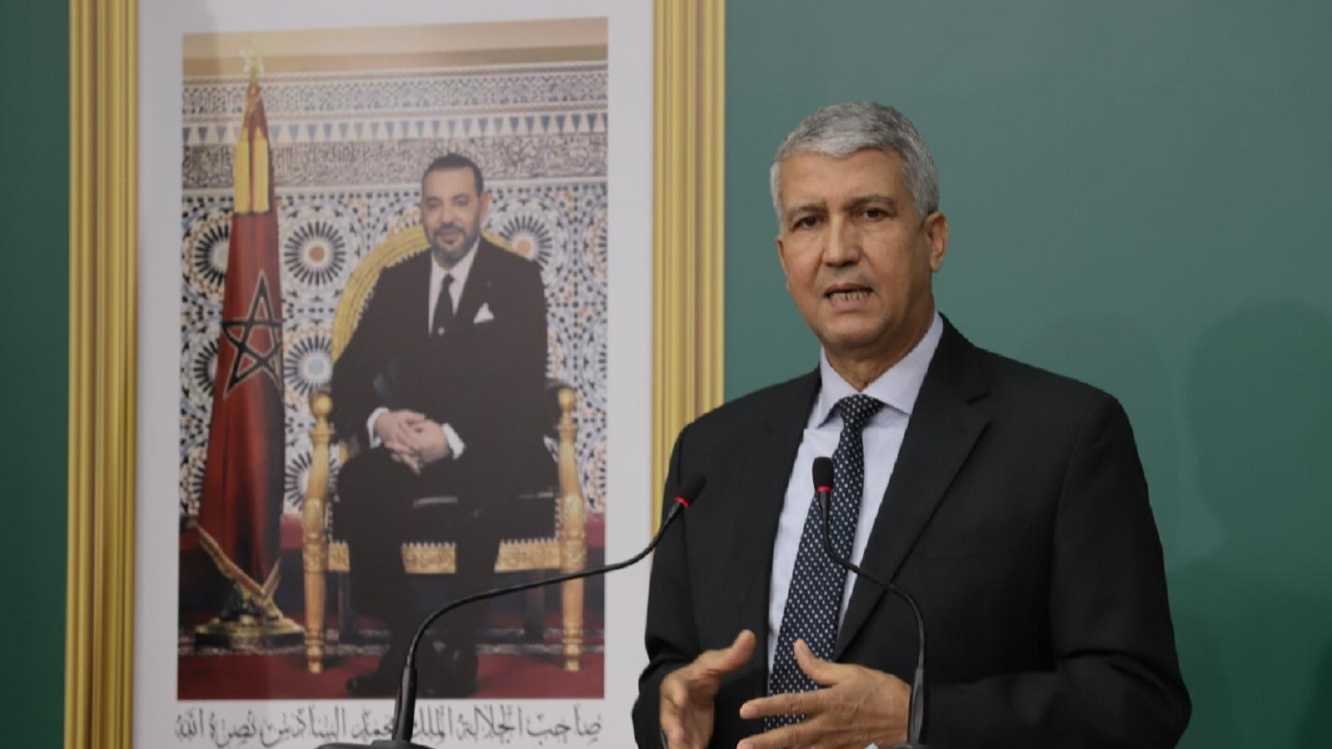

Speaking at a conference entitled “Water and Food Security: Resilience and Sustainability”, held as part of the conference-debate cycle of the Center for Legal, Economic, and Social Studies (LINKS), Sadiki pointed out that structuring public investments are being undertaken to develop water supply and demand management, in the service of the Kingdom’s food sovereignty.
The Minister cited the construction of new dams, the interconnection of water basins (Sebou-Bouregreg-Oum Rbia-Tensift, Loukkos-Tangérois) and the development of desalination.
Recalling the launch last Monday by HRH Crown Prince Moulay El Hassan of the construction works of the Casablanca desalination plant, the largest in Africa, Sadiki explained that the seawater desalination program will reduce pressure on conventional water resources and free up these resources to consolidate the gains made by irrigated agriculture.
Stressing that water governance plays a decisive role in strengthening food sovereignty, the Minister emphasized the need to speed up implementation of the National Program for Drinking Water Supply and Irrigation (PNAEPI) (2020-2027) and the Generation Green strategy (2020-2030).
In this context, he pointed out that the PNAEPI provides for an exceptional investment effort of 165 billion dirhams, while the Generation Green strategy aims to establish a resilient and efficient agriculture for an overall investment of 50 billion dirhams, through the modernization of irrigation systems, the development of non-conventional water irrigation, the valorization of water resources mobilized by dams and the development of small-scale irrigated agriculture.
Highlighting the outcome of water-saving initiatives, Sadiki underlined that by the end of 2023, 824,000 hectares (50% of irrigated area) would already be under localized irrigation, with the aim of reaching one million hectares under localized irrigation by 2030.
With regard to measures aimed at developing resilient and eco-efficient agriculture, the Minister noted, among other things, investment in water and energy efficiency